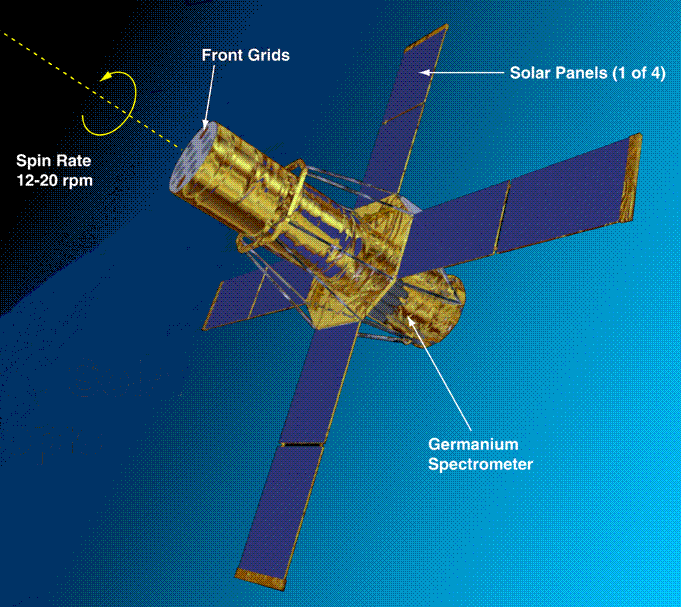
The HESSI mission consists of a single spin-stabilized spacecraft in a low-altitude orbit inclined 38 degrees to the Earth's equator. The only instrument on board is an imaging spectrometer with the ability to obtain high fidelity color movies of solar flares in X rays and gamma rays. It uses two new complementary technologies: fine grids to modulate the solar radiation, and germanium detectors to measure the energy of each photon very precisely.
HESSI's imaging capability is achieved with fine tungsten and/or molybdenum grids that modulate the solar X-ray flux as the spacecraft rotates at ~ 15 rpm. Up to 20 detailed images can be obtained per second. This is sufficient to track the electrons as they travel from their acceleration site, believed to be in the solar corona, and slow down on their way to the lower solar atmosphere.
The high-resolution spectroscopy is achieved with 9 cooled germanium crystals that detect the X-ray and gamma-ray photons transmitted through the grids over the broad energy range of 3 keV to 20 MeV. Their fine energy resolution of about 1 keV is more than sufficient to reveal the detailed features of the X-ray and gamma-ray spectra, clues to the nature of the electron and ion acceleration processes.
A spinning spacecraft pointing at or near Sun center provides a simple and reliable way to achieve the rotation required for the HESSI imaging technique. A low-altitude equatorial orbit that can be reached with a Pegasus launch vehicle is chosen to minimize damage to the germanium detectors from the charged particles in the Earth's radiation belts.
Context observations from ground-based observatories and a theory program are also integral parts of the HESSI mission. Ground-based optical and radio telescopes will provide complementary data on the magnetic fields, electric currents, hot plasma, and the energetic electrons in the flaring regions where the X-ray and gamma-ray emissions are generated. Also, it is hoped that other spacecraft will provide additional simultaneous observations of the thermal and dynamic environment to further enhance our knowledge of the conditions in the flaring region.
[Information provided by NASA.]
Group: Platform_Details
Entry_ID: HESSI
Group: Platform_Identification
Platform_Category: Solar/Space Observation Satellites
Short_Name: HESSI
Long_Name: High Energy Solar Spectroscopic Imager
End_Group
Group: Synonymous_Platform_Names
Short_Name: HESSI
End_Group
Group: Platform_Associated_Instruments
Short_Name: POLARIMETERS
Short_Name: SPECTROGRAPHS
Short_Name: WAVES
Short_Name: VECTOR MAGNETOGRAPHS
End_Group
Group: Orbit
Orbit_Altitude: 600 km
Orbit_Inclination: 38 degrees
End_Group
Creation_Date: 2007-08-13
Online_Resource: http://hesperia.gsfc.nasa.gov/hessi/
Sample_Image: http://hesperia.gsfc.nasa.gov/hessi/images/hessicraft.gif
Group: Platform_Logistics
Launch_Date: 2002-02-05
Launch_Site: Cape Canaveral/Kennedy Space Center, USA
Design_Life: 2 years
Primary_Sponsor: NASA
End_Group
End_Group (en)